

News
The Weight of the Badge: Saka’s Groin, the NLD, and the Loneliness of the Local Hero

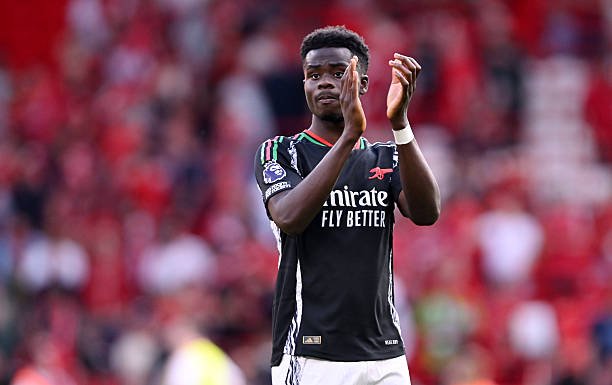
Bukayo Saka has not started a football match in eleven days. For most players, this is recovery. For Saka, it is confinement.
The groin strain that forced him to withdraw from the Liverpool thriller has been managed with the caution reserved for museum artifacts. Every training session is measured. Every press conference mention is parsed for hidden timelines. February 11th, 2026, according to the unofficial calendar, is the date the North London Derby reclaims its most precious asset.
But Saka’s injury is not merely physical. It is psychological inheritance.
The Contract No One Signed
Saka was born in Ealing, but he belongs to Islington. He arrived at Hale End at eight years old. He has never known a professional existence outside Arsenal’s postcodes. This makes him something increasingly rare in elite football: a one-club man in waiting.
It also makes him the repository of every supporter’s unfulfilled dream.
When a foreign signing misses a decisive penalty, the grief is tactical. When Saka missed one at Euro 2020, the grief was familial. The nation forgave him; Arsenal fans did not need to forgive. They simply absorbed his pain as their own. This is the contract Saka never signed: his triumphs are communal property, and his injuries are community wounds.
The NLD and the Scrutiny Spiral
The North London Derby is not a normal fixture. It is a psychological stress test administered twice a season. For a local hero returning from injury, the test is crueller.
Every misplaced touch will be analysed not as rust, but as evidence of permanent decline. Every successful dribble will be celebrated not as competence, but as resurrection. There is no neutral ground. Saka will enter the Tottenham Hotspur Stadium knowing that 60,000 opposition fans are not merely hoping he fails – they are expecting his fragility.
This is the loneliness. Teammates can empathize. They cannot share the burden. Ødegaard is revered; Saka is adopted. The difference is existential.
Arteta’s Calculated Milestones
Arteta’s decision to target the NLD for Saka’s return is not medical optimism. It is psychological inoculation.
By publicly framing the derby as Saka’s comeback date, Arteta has done two things. First, he has given Saka a fixed horizon – essential for athletes who deteriorate in ambiguous timelines. Second, he has normalized the anxiety. The narrative is no longer “Will Saka be fit?” It is “Saka will be fit for the derby, and that is the plan.” Uncertainty has been replaced by appointment viewing.
What Saka Carries
When Saka steps onto that pitch, he will carry a groin at 80% capacity. He will carry the weight of a club that has not won the league in twenty-two years. He will carry the memory of every Hale End coach who told him he was special.
And he will carry the quiet knowledge that he is the only player in Arsenal’s squad for whom defeat is not professional disappointment – it is personal betrayal.
The loneliness of the local hero is that he cannot leave. Even if he wanted to – and he does not – the contract signed at eight years old binds him to a place that demands his excellence as repayment for his upbringing.
Bukayo Saka does not play for Arsenal. He is Arsenal. And on February 11th, he will run onto the grass at Tottenham and prove, once again, that some weights are not meant to be lifted alone.